This is a joyous story, a story of music, and storytelling, and magic. This is also a story about coming very nearly full circle, when weary beliefs are set aside for the sake of the craic and the cheol. It’s one I share with more than 1 million people, and that I am now honored to share with you.
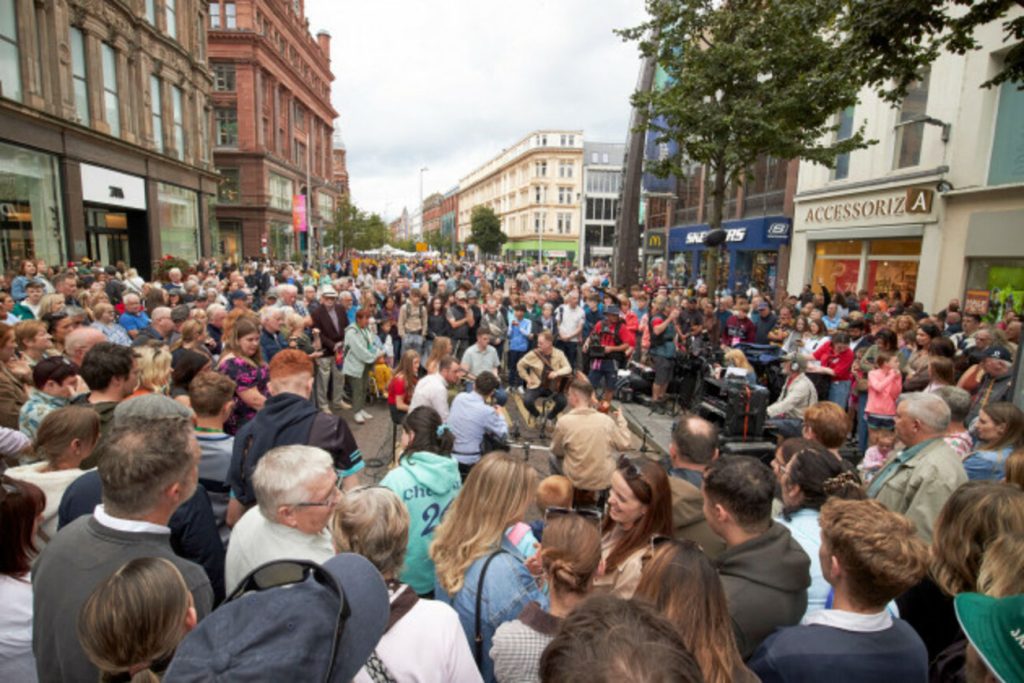
I moved from Maine to Ireland more than six years ago, and in that time I have journeyed throughout this island and had many heartening experiences. Still, I was unprepared for the pure happiness I felt when I and my 1.6 million companions wandered the streets, alleys, pubs (oh yes, the pubs) and cultural centers of Belfast at the Fleadh Cheol 2026. And every last one of us with the same loopy grin.
The Fleadh Cheol (pronounced flah key-ol, or Gathering of Musicians) is an annual and traveling festival of traditional Irish music and dance, held in one place for no more than a few years. The Fleadh, as it’s known, is a calling of musicians from the length and breadth of Ireland, from wee lads and lasses to grizzled men with gnarled hands, to share the love of their instrument and their voice with those of us who love to listen.
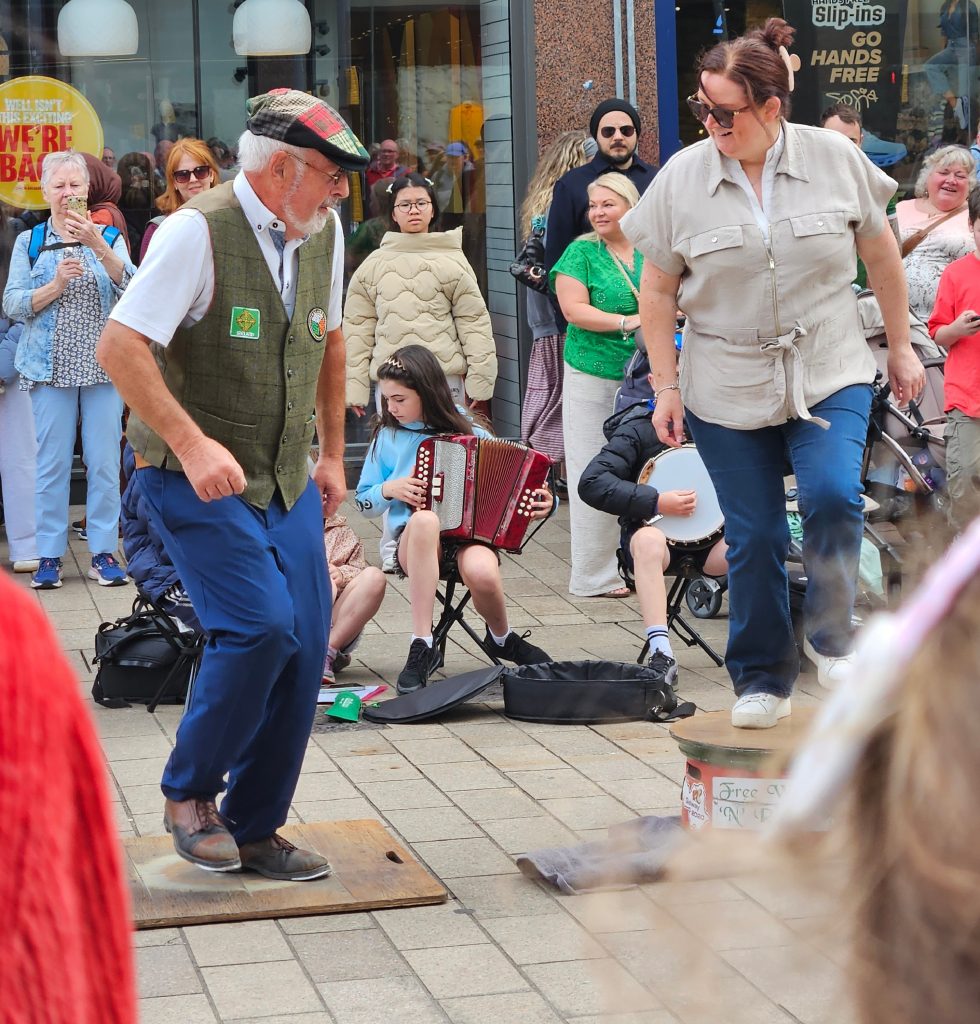
I would arise each morning and head out into the world of the Fleadh, £1 coins jingling in my pocket to flip into the open flute or bodhran or fiddle cases of the buskers and dancers who were everywhere in profusion. Here might be two young boys, a fiddle player and an accordion player, say, playing their hearts out. There, I might see two or three young step dancers on their portable dance floor, backs straight and feet flying. In between, a storyteller might weave the tales and lore of Ireland.
And that was just the informal part.
Belfast Fleadh organizers had planned a vast array of core events and fringe events throughout the city, which ran the gamut from ceili bands with Irish set dancers, to orchestras, to marching bands (more about this to come) to singing sessions. The ‘gig rig’, a centerpiece of every fleadh, showcased performers from across the island from 11am to 11pm every day. And the pubs, not to be undone, hired bands for the evenings. The strains of Black Velvet Band or Whiskey in the Jar or Raglan Road were heard in many a nook and cranny, along with Northern Ireland odes I had not heard before, like Belfast or I Wish I was Back Home in Derry. I could experience only a fraction of what was on offer, more is the pity, even though I assure you, I did try to see it all.
And all of this took place in a city that for one week pedestrianized just about every major thoroughfare and many side streets as well. Trash and recycle bins were everywhere and cleaned regularly. An army of volunteers in yellow vests answered questions or gave directions. So this wonderful musical experience was held in a place that actually gave a damn whether you had the best time.
Although we were all fortunate to partake in the embarrassment of riches that was the 2026 Fleadh, its origins harken back to a time in the mid-20th century when traditional Irish music was at risk of disappearing. In the 1950s, the post WWII economy may have been booming in the US, but Ireland’s was decidedly not. As Irish Times columnist Fintan O’Toole says in his thought-provoking book ‘We Don’t Know Ourselves’, this stagnation was exacerbated by the grip of the Catholic Church, strong farmers’ organizations that wanted the country to remain rural and a rejection in the Dail Eireann of modernization measure put forth by a handful of forward-thinking government ministers.
With this came a concomitant neglect of the Irish culture, language and music. Some of the most heralded Irish playwrights of the 20th century – Beckett, Shaw, O’Casey – no longer lived in Ireland, and all saw plays of theirs scuttled by the Irish Catholic hierarchy.
Traditional Irish music was confined to rural and disparate communities. Those of you who have read ‘This is Happiness’ by Niall Williams, set where I live in County Clare in the 1950s, may recall the attempts by young Noel Crowe to hear the elusive (and very real) fiddle player Junior Crehen. Crehen was local to Clare, playing Clare tunes for Clare people, and his itinerate musical counterparts were to be found in other counties, playing equally local tunes.
Into this environment, Comhaltas Ceoltoiri Eireann (in English the Gathering of Musicians of Ireland) was formed in 1951 to provide a home for Irish culture, particularly traditional music and dance. There were fiddle players and bodhran players and accordion players and flute players in these rural counties keeping their local traditional music alive, even if only in house concerts and rural pubs. Comhaltas worked to bring all these musicians together under one umbrella organization to strengthen and support these cultural touchstones. In fact, Junior Crehen was at one point the president of the Comhaltas Clare branch.
They agreed to create a Fleadh Cheoil to be held in different towns throughout Ireland, with the goal of drawing traditional musicians from throughout the country who would perform to a wider audience than in their home place. Thus, they hoped, the decline of this very Irish of musical forms would be reversed. The cornerstone would be a competition showcasing the most promising young musicians in Ireland, some of whom would win medals and bragging rights back home. This remains an important part of every Fleadh, and in fact youngsters from my little village and those surrounding travelled to Belfast to compete.
By any measure, though, the 2026 Fleadh was historic in its own right, in a city and a region that not that many years ago was synonymous with armed conflict. I think those of us at the Fleadh felt this in our very souls. It was the music, of course, but it was so much more than the music. We felt a part of something bigger than ourselves.
While the Belfast Fleadh Executive Committee could imagine this wild dream into reality, there were surely more than few Northern Ireland folks who must have thought they were quite mad. The sectarian violence which marked that land for so many decades is well within the memory of many. And while the Good Friday agreement was signed 28 years ago, in my limited experience it would not be amiss to say that there remain undercurrents of tension.
But the committee was determined to present a Fleadh that was inclusive and welcoming of all. ‘From the outset, we wanted all communities to be involved here,’ said committee member Brendan McAleer in an interview on the online news publication Belfast Live. ‘We wanted everyone in the city to see what the power of music can do for Belfast, for Northern Ireland and for all of Ireland. This has been a moment. I think Belfast has been ready for it.’
And that certainly proved true among those of a certain age who were interviewed by news organizations during the Fleadh. More than one recalled the ‘ring of steel’ which surrounded the city from 1972 to 1998, a security cordon of checkpoints, turnstiles and metal gates staffed by the British Army. In fact, I remember this cordon when I visited Belfast with my brother in the late 1970s. The city was an urban war zone, with bombed out buildings and soldiers hefting rifles patrolling the streets.
But on the streets of Belfast during the Fleadh these many years later, people shared their sheer delight. ‘If anyone had told us in those days that this would be happening here, it would have been a fairy tale,’ a 66-year-old woman told the New York Times. ‘We wouldn’t have believed them.’ ‘These are the streets where people used to die,’ peace campaigner Gerry Grehen told the BBC. ‘And there were people dancing in these same streets. It brought tears to my eyes. Tears of joy.’
If proof was needed, one need look no further than a post that was published on the Facebook page of the Shankill Road Defenders Flute Band. This unionist band was among quite a few marching bands invited to participate in the Fleadh. The marching band tradition is an ingrained part of the unionist culture in Northern Ireland, and among those ‘communities’ that the Fleadh Committee wanted represented.
After thanking Comhaltas for the ‘warmth with which we were received,’ the post went on to say the band was ‘completed overwhelmed’ by its positive reception. ‘It’s quite surreal – we have had comments and messages from every corner of the Republic of Ireland and here at home, and from the most unlikeliest of places, namely the Falls Road’ – the road as synonymous with Catholics as Shankill Road is of Protestants.
I will tell you, this very nearly brought a tear to my eye. If those with ingrained beliefs of generations can find such graciousness in their hearts, who is to say what this bodes for the people of Northern Ireland – but also for the people of Israel, the United States, for all far-flung places in the world where divides seem intractable. May it be so.
Deborah,
Ron would have loved this blog as Belfast , then and now, had always held a “special place in his heart!”
Thanks Deb. I’m still brought down by the current sectarian divisions in the US, so a bit of hope is warmly welcomed.
Another great travel blog.
Every time I read one it makes me want to visit Ireland even more!
Wonderful Deborah. I feel the dancing in my bones and the music in my heart.
Thank you !!
Thanks for sharing this wonderful event. I feel your teardrops while being so moved from the music, dancing and being surrounded by the people who all share this joyous event.
Glad to see you’re still exploring, writing and sharing with all of us.