Greetings from across the pond!
I put my traveling shoes on during the late spring and summer, heading to France and Scotland, as well as right here in Ireland – and I’d love to share some of the highlights with you. To make your reading experience somewhat digestible, I’m going to write several blogs over the course of the next few weeks about these adventures.
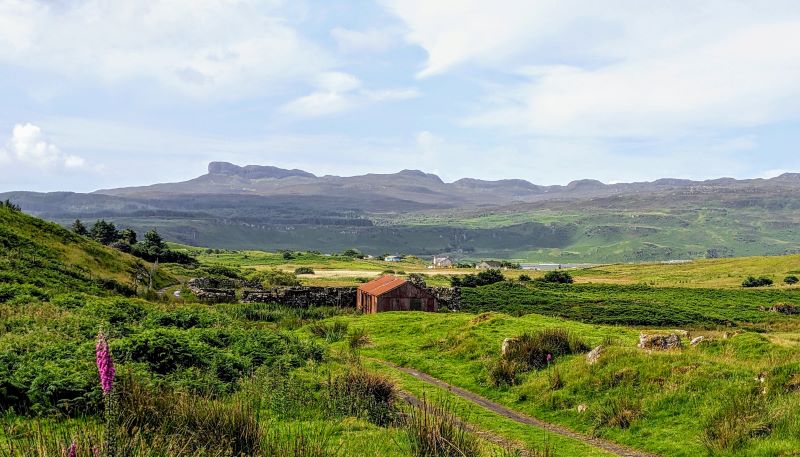
I’ll begin my journey in Scotland, a magical, misty land. The photo above was taken from Eigg Island in the Inner Hebrides. But before I start, I’d be remiss if I didn’t first talk a bit about travel itself during these unsettled times. Certainly, during the early months of the Trump administration, a lot of Americans who live here in Ireland were highly concerned about traveling home to the States. As I’m sure you’ve read, people were talking about wiping their mobile phones and laptops clean of any ‘left leaning’ groups on social media or leaving them at home altogether, and making arrangements with friends or family on both sides of the Atlantic in case they were taken into custody.
In the time since, those concerns apparently have proven largely – although by no stretch completely – unwarranted. I belong to two Americans in Ireland Facebook groups, and most members have reported that they have easily traveled into and out of the US without any problems. I’m mindful, however, that this is a snapshot of today, and the situation could change at any time.
We are lucky here in Ireland in that passengers travelling from Dublin and Shannon go through US Customs and Border Protection at those airports and not in the United States. Ireland is the only location in Europe where this is the case, and it does create a sense of calm among Americans going home. The logic is that the customs folks, who not only work but live in Ireland, have been imbued with a bit of the Irish spirit. When I went back to Maine recently, that certainly proved true. The customs officer smiled politely during our brief exchange.
Having said that, it does appear that the number of European visitors to the US and US visitors to Europe was down significantly this summer. According to a recent study by the World Travel and Tourism Council, the US is poised to lose $12.5 billion in international visitor spending this year. A number of European countries are advising their residents to be cautious about travel to the US, particularly transgender people, people with previous US convictions or those who in the past overstayed VISAs.
But Americans are apparently wary of traveling abroad as well. Travel to Europe from the US is expected to drop by 7 percent this year as compared to 2024, according to the European Travel Commission, spurred by “rising costs and political concerns, including unease over how the US is perceived abroad, which is dampening enthusiasm.”
Also, better the devil you know, right? If you’re going to travel, travel in the US. That way you don’t have to worry about pesky customs, particularly if you don’t accord with the American image that is de rigueur at the moment…
Plus, the US/Euro exchange rate is awful. I know this from personal experience. Each month, I transfer my Social Security payment and small pension into my Irish bank account from my US account. I have routinely lost 8-11 percent of the money due to the exchange rate that favors the Euro; but since February, things have started to go haywire. In July, I lost a whopping 16 percent, and I cringe monthly wondering if it’s going to get even worse. With the dollar nowhere near on parity with the euro, this could be a very practical reason why people aren’t traveling across the pond. And the exchange rate is even more disastrous for those traveling to Great Britain. Right now, the pound equals €1.15 and $1.33 USD.
I’m mindful that for all these reasons, people may choose to be armchair tourists in 2025. And who can blame you? So even more reason for me to take you along on my journeys. First stop, Scotland.
***
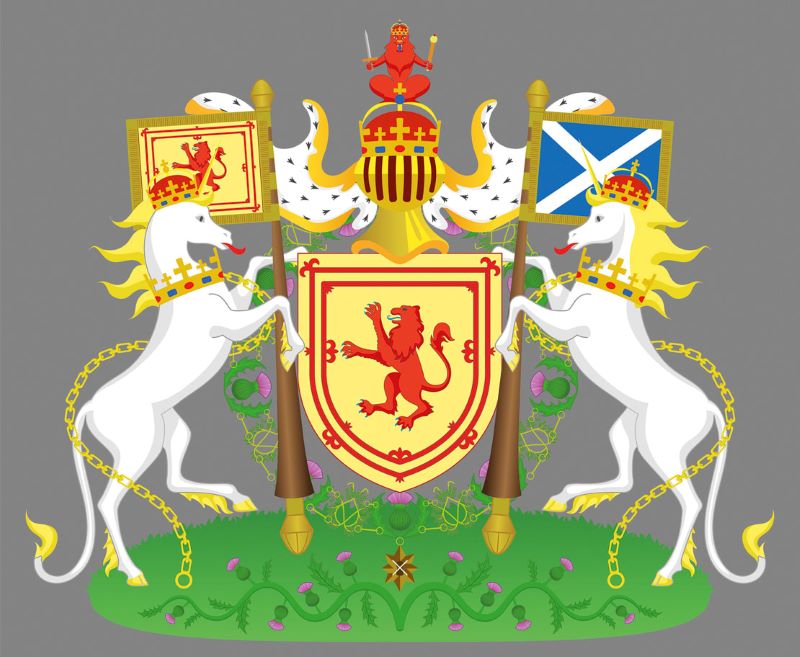
All you need to know about Scotland can be learned from the unicorn. This is the country’s national animal, and it epitomizes the land, its mystic tales, its history. In my brief time there, it seemed to me that mythology was everywhere in attendance, almost as if the elusive unicorn could be seen roaming the misty mountains or boglands. I love Ireland most because it is so deeply ancient, and it comes as no surprise to me that Gaelic Scotland resonated with me as well. Indeed the first settlers to Ireland arrived from Scotland around 7,000 BC. Gods, goddesses, place names, all are shared.
The Scottish unicorn also has deep ties in the Scottish national identity. It is not a white horse with a horn, as typically depicted, but an amalgam of animals: a horse body, a goat head, goatee and cloven hoof, a lion’s tail – representing wildness, cleverness, power, strength and purity. It first appeared on the Scottish coat of arms in the 12th century and was codified somewhat on coins and official seals during the 15th century when an independent Scotland was ruled by its own kings.
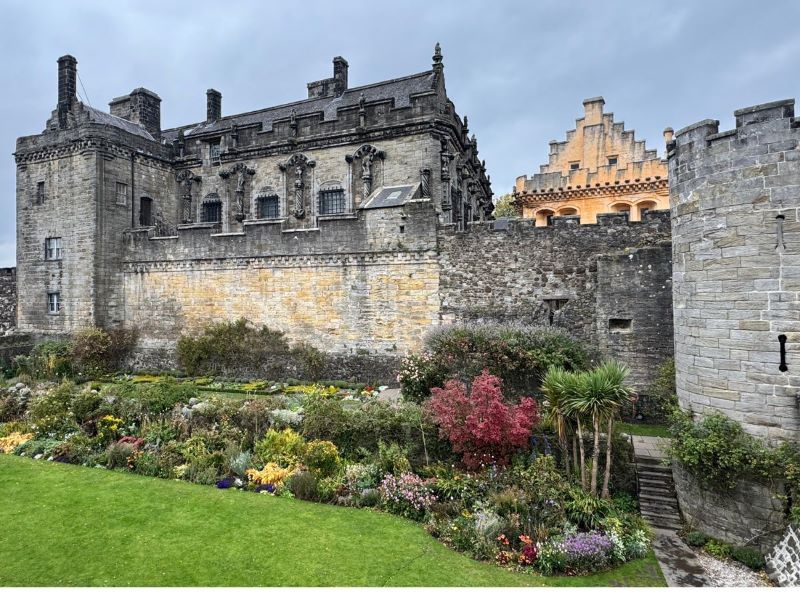
The well-maintained (and imposing) Sterling Castle
And the unicorn is everywhere present at Sterling Castle, our first stop on our way to the west of Scotland from Edinburgh, where my friend and travelling companion Peg lives. Stirling Castle is arguably as pivotal to Scottish history as it is possible to be. Located in the town of the same name, it had been home off and on to Scottish royalty since the 10th century (off most notably when England took the castle during its wars with Scotland, which were often). Its heyday was in the 15th and 16th century, when the Stewart monarchs ruled and Stirling was their primary residence. Mary Queen of Scots was born and inaugurated there. James VI, who as James I also ruled England in the early 17th century, also called Stirling Castle home.
It’s a lush, enormous, well-preserved castle well worth the visit. Plus, it’s an easy one-day outing from Edinburgh and is on the train line. Although only a part of the compound itself is open to visitors, our gregarious, knowledgeable, twinkle-eyed Scottish guide made it all so enjoyable. The castle is open year round. Buy your tickets online and save yourself a pound or two: £18.50 for adults, ($24.60USD), £15 for seniors (oddly, called the concession rate), less for children and family rates.
From Sterling, we traveled north and west, into the heart of the Scottish Highlands and a land the likes of which I’ve never seen before. Perhaps the words ‘rugged beauty’ are overused, even a bit trite, but they hold true for this part of the world. Mountains jut up in profusion, lake upon undeveloped lake snake lazily along the roadside, villages are sparsely found. The landscape is, quite simply, otherworldly, as if you’ve wandered into some unremembered past.
A word to the wise if you travel there, though. Pack for all weather eventualities. I thought the west of Ireland had a corner on the market when it came to mercurial weather. Not so! I went to Scotland at the end of June, and brought a fleece-lined jacket, a rain jacket, rain pants, waterproof shoes, a warm zip-up hoodie, thermal underwear tops, fleece-lined leggings, in addition to long-sleeved tops. I did bring a short-sleeved top, but it sat unused. And I still didn’t always feel warm. However, I was always dry, no small thing when that rain descends from the mountains or across the sea unbidden.
I want to share something with you that I don’t think most people know about the Highlands – including me until recently. Most of it is owned by a few large landowners. In fact, Scotland has the most concentrated pattern of private land ownership in the developed world, according to Community Land Scotland – some 430 people own 57 percent of the entire country. The largest landowner, Danish billionaire Anders Povlsen, owns an unimaginable 221,000 Highland acres. The Crown owns another 11 percent. The land remains wild, and many landowners including Povlsen have said they want to keep it that way, but questions and concerns arise when landed wealth is in so few hands. Land reform remains a struggle in Scotland.
A very different kind of land ownership model is found on the Isle of Eigg, where Peg and I spent several days. Eigg (yes, pronounced egg) is one of more than 700 islands off the coast of Scotland, most of them in the Highlands. We chose Eigg because I had hoped to visit an island and, really beyond that, basically for why not. And it did not disappoint, for many reasons.
Chief among them is its ownership model. In 1997, the Isle of Eigg Heritage Trust bought the island for £1.5 million from its previous landlord, who had offered little in the way of employment opportunities, infrastructure, housing or sustainability. Now, the 90-odd island residents themselves chart their future. As a result, they built and run a center that houses a restaurant, post office, shops and business offices. They have their own wood supply, small-scale renewable energy projects, broadband network, website and construction company that renovates and builds housing for islanders. Very cool.
Eigg, like I suspect most islands in Scotland, seems to attract sturdy folk — walkers, hikers, naturalists, people not daunted by adverse weather or craggy landscape. Indeed, the outdoors is your living room and garden, and adventures abound.
The island is dominated by An Sgurr, a 1,290-foot promontory that is everywhere present. It was the backdrop for a guided walk we took with on, who with his partner Kat own the Isle of Eigg Guiding Company. Our destination was a clearance village. It seems Ireland doesn’t have a corner on the market when it comes to cruel English landowners. From the mid-18th to the mid-19th centuries, landlords forcibly removed Highland residents on mainland and island from their homes as they transitioned from traditional agriculture to more profitable sheep farming. Many villages, like the one on Eigg, were abandoned altogether. The remnants of the village are still there, a powerful reminder of inhumanity. (And need I say it, perhaps why the current 21st century Highland property owners are viewed with some historical skepticism.)
Peg and I rented e-bikes from Eigg Adventures, well worth the £40 daily rate (about $53, with that tanking US exchange rate; or €46) in order to navigate the hilly terrain. Our travels took us to the north side of the island, through the small village of Cleadale and to a stone circle probably dating to the Bronze Age and used for ceremonial purposes. Indeed, the first inhabitants of the island arrived 8,000 years ago, so there is plenty to see for the budding archaeologist or geologist. And we learned about the botany and wildlife of the island during a free guided walk offered by the Scottish Wildlife Trust every Wednesday in the summer.
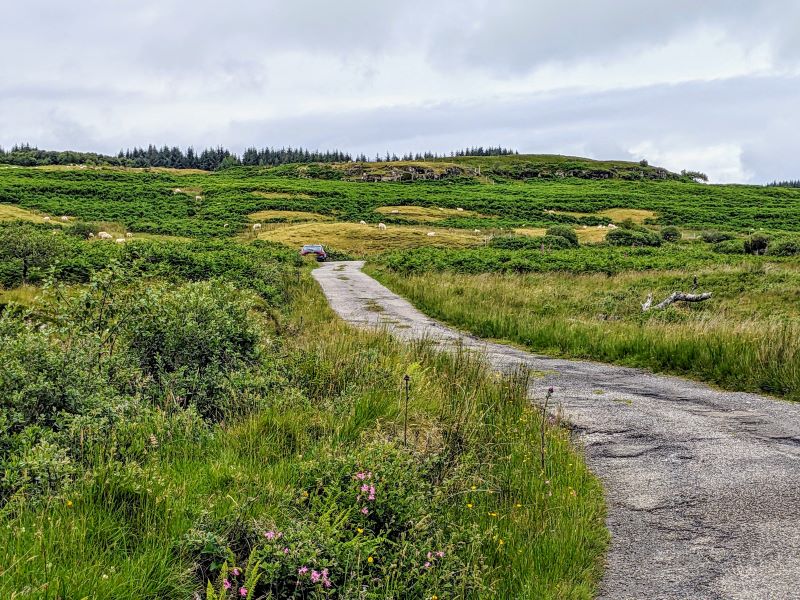
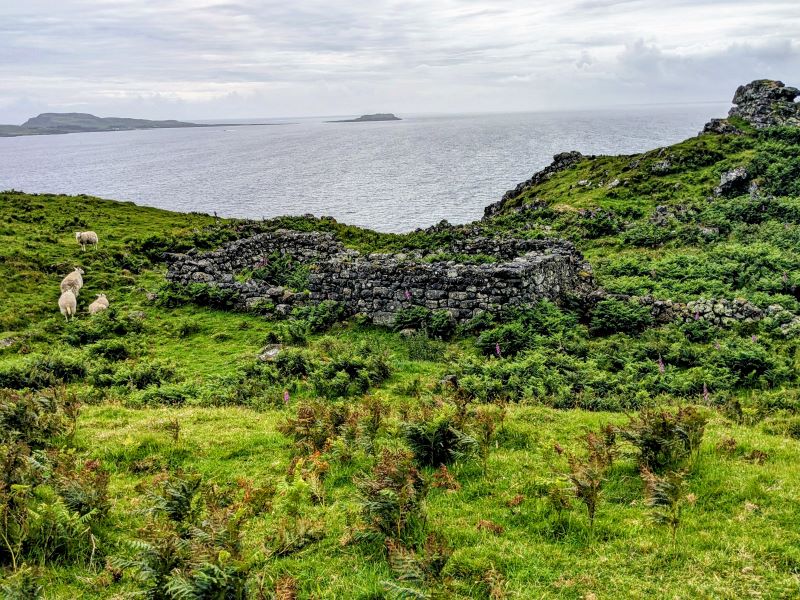
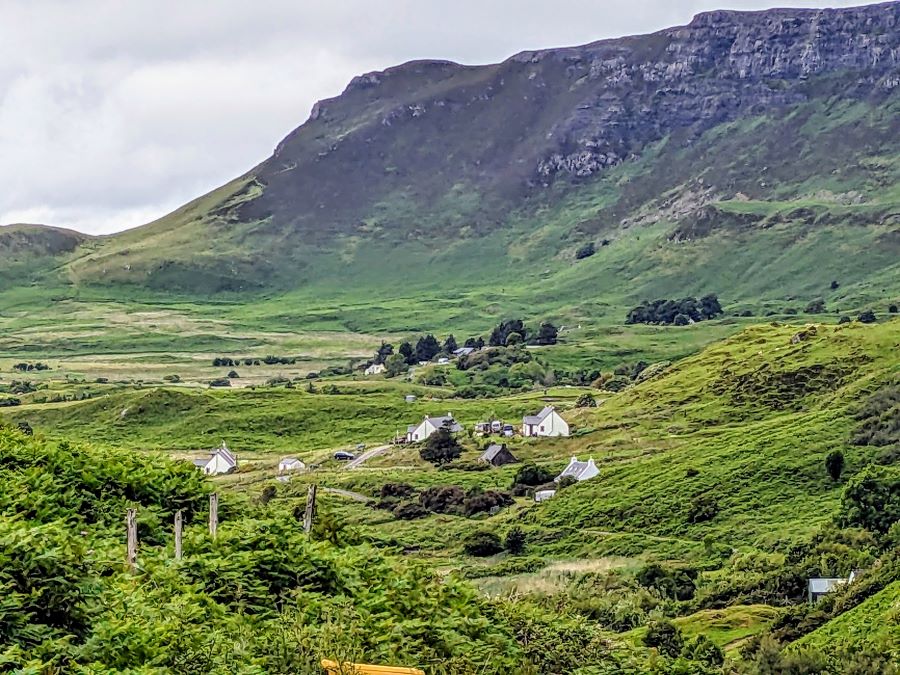
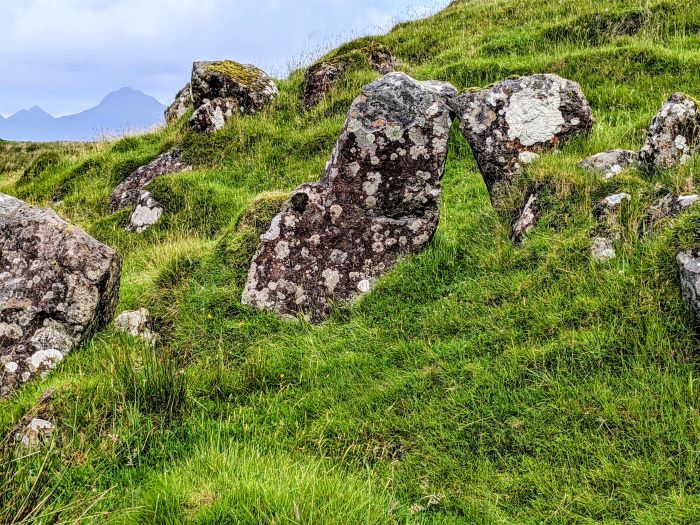
From top left: A road wends through the lowlands on Eigg Island; A ruined house foundation in the clearance village; just a great photo to give you a sense of the majesty; the portal stones leading into the stone circle. The lead photo gives a sweeping view on the island with An Sgurr rising in the distance.
Eigg is in the Inner Hebridies. To get there, head to the village of Arisaig, where you can catch a ferry that operates every day during the summer months. Advanced planning, though, is a must, as accommodation is quite limited. Peg and I stayed at the Glebe Barn, a hostel where we met a fine assortment of folks from college students to veteran trekkers of all ages. We did stay in a two-bed room, not a dormitory, but Peg also booked in February. There is other accommodation available, but book early. Do your food shopping on the mainland, as the grocery store offers limited items. But do take in a meal at the Galmisdale Bay Café by the pier. I can particularly recommend the pizza. For all things Eigg, visit the island’s self-run and very informative website.
Once back on the mainland, we traveled from Arisaig south along the coast to the Argyll region of the Highlands, spending time in Kilmartin Glen near the lovely town of Lockgilphead. Peg specifically chose this area for me because it is in the heart of ancient Scotland. Fully aware that I face the potential of glazed eyes from you folks (oh no, not ANOTHER archaeological romp!), I will nonetheless persevere because this area is just so fascinating.
One of Ireland’s most visited monuments is the 5,000-year-old passage tomb at Newgrange. Here, huge curbstones surround the tomb, engraved with symbols of all sorts that remain an enigma to the experts. When I was taking my archaeology classes, I learned that similar megalithic art is found on the stone sheets at Achnabreck in Kilmartin Glen. Well, of course I wanted to check it out. And there they were, particularly the spirals that are in profusion at both places. It’s interesting to consider the ties that bind these two Neolithic era sites. At the least, the similar art forms suggest travel, perhaps a shared spiritual belief.
Two well-marked parking lots (one wheelchair accessible) can be found on the quite remote road to Achnabreck, and the site itself is well maintained by Historic Environment Scotland.
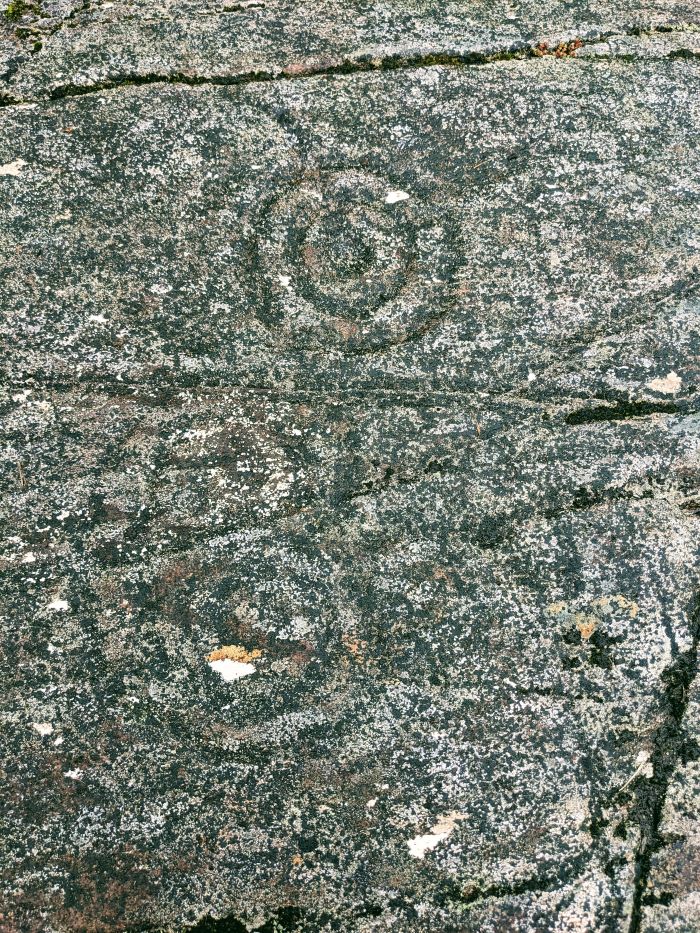
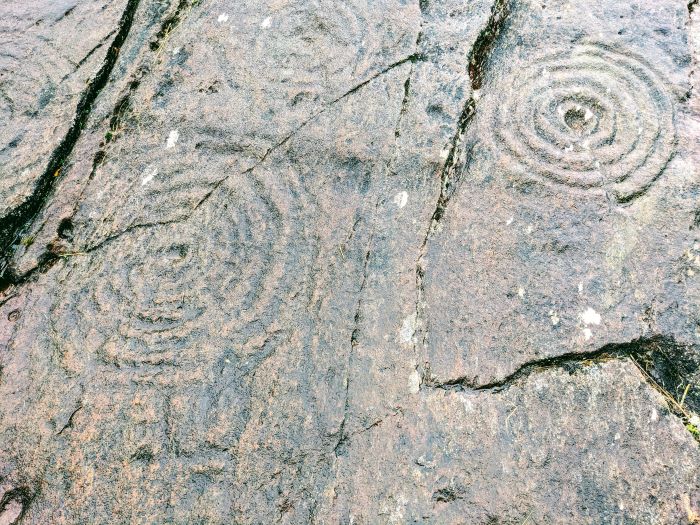
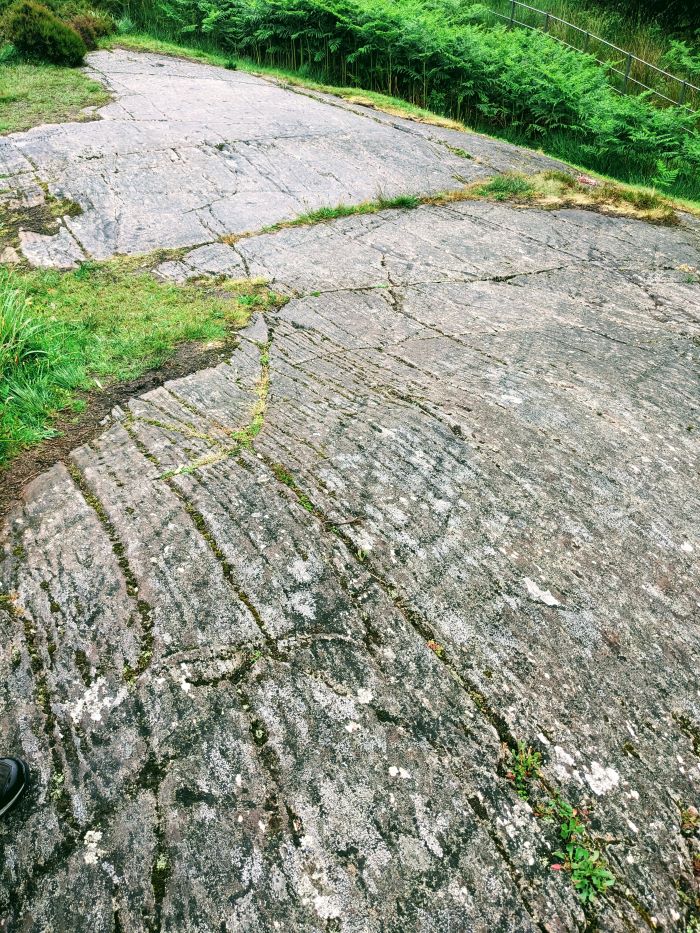
The Achnabreck stone sheets. Really these are just carved into the stone. They were apparently discovered when someone lifted up the thin layer of grass that had been growing on top of them. Really quite something.
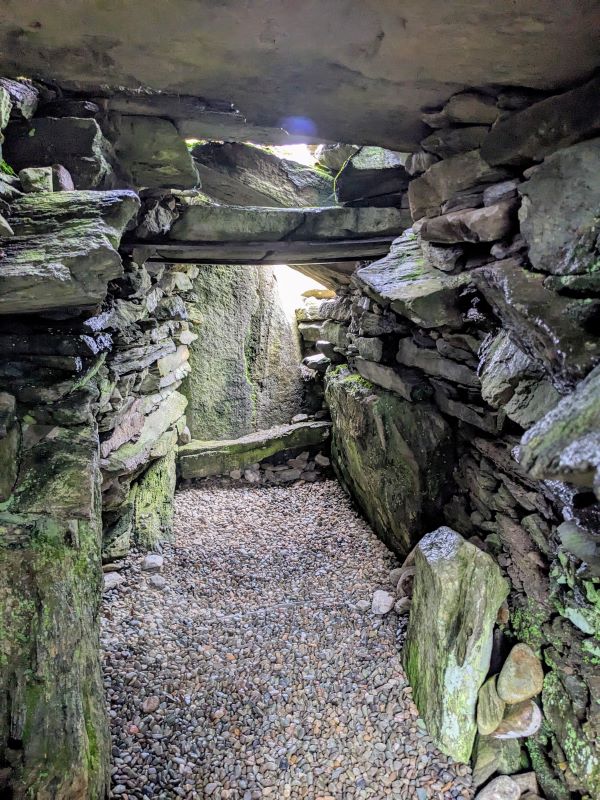
Stay in that Neolithic/early Bronze Age period when you wander just down the road to the Nether Largie complex in Kilmartin Glen. Here, in one 2-kilometer area, are two stone circles, five standing stones and three rather prominent cairns, all on roughly a north-south axis – making this a place of high ritual importance for as many as 2,000 years. The standing stones were likely astronomical in nature, tracking moon and sun movements. The Temple Wood stone circles are where ritual ceremonies took place. Archaeological evidence suggests the three cairns were used, and sometimes enlarged, over many years. Not to be too woo-woo about it, but energy abounds at Nether Largie, and a sacredness.
Public parking for this complex is difficult to find; signage is poorly located and quite small. Coming from Kilmartin, take the right past the standing stones, where you will find a car park.
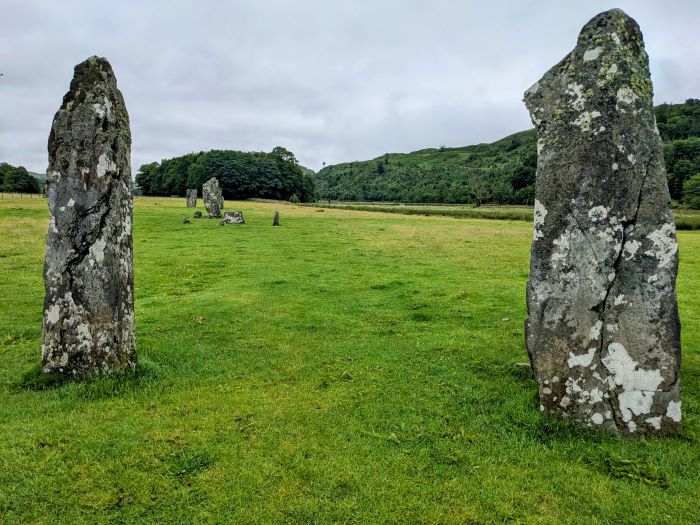
The Nether Largie standing stones; and the interior of the Nether Largie Mid Cairn, believed to be the oldest of the three cairns at the complex.
Fast forward more than 3,000 years, and we explored another – and exceedingly unexpected – connection between Ireland and Scotland. Dunaad Fort rises above the flat terrain in the Glen, an unmistakable feature on the landscape. Here was the center of the Kingdom of Dal Riata, which spanned Scotland and County Antrim, Ireland, from which the first kings descended. This Iron Age fort believed to be founded around 500 AD, has many of the earmarks of the great kingly inauguration sites of Ireland: an elevated location from which the entire countryside below could be seen in all directions; a processional pathway; an inauguration stone replete with print of a sandaled foot. To roam this place is to feel the power of the past. If you ever do find your way to Argyll, I highly recommend this place.
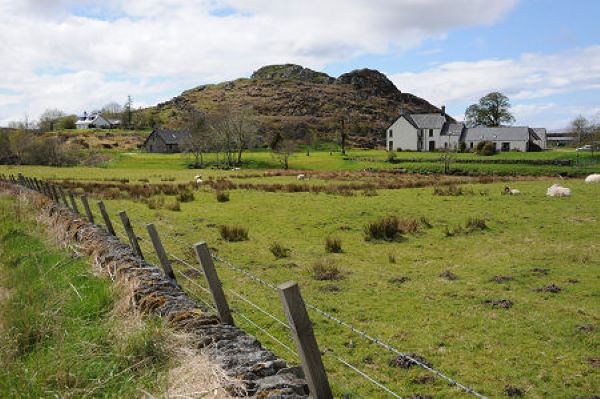
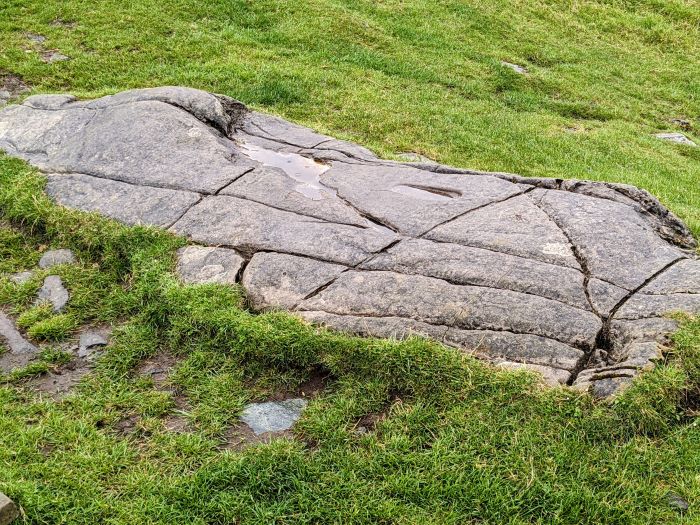
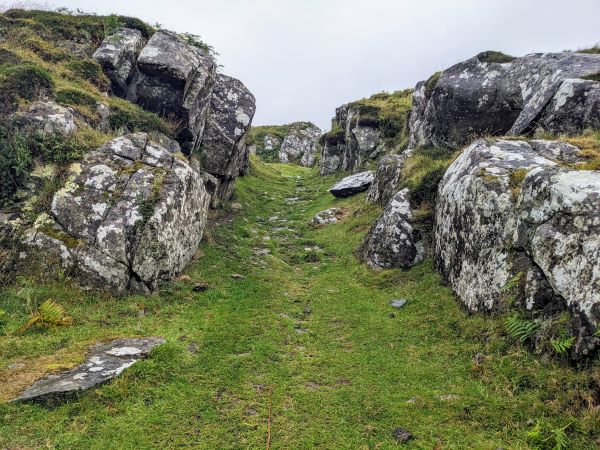
Dunaad Fort rises from the landscape; the inauguration stone at the summit (you can see an impression in the stone for a sandaled foot); and the amazing processional way up the hill to the summit. Really, walking up this path was awesome.
More information about these and other monuments can be found at the Kilmartin Museum, which also boasts a most delightful restaurant with glass room dining.
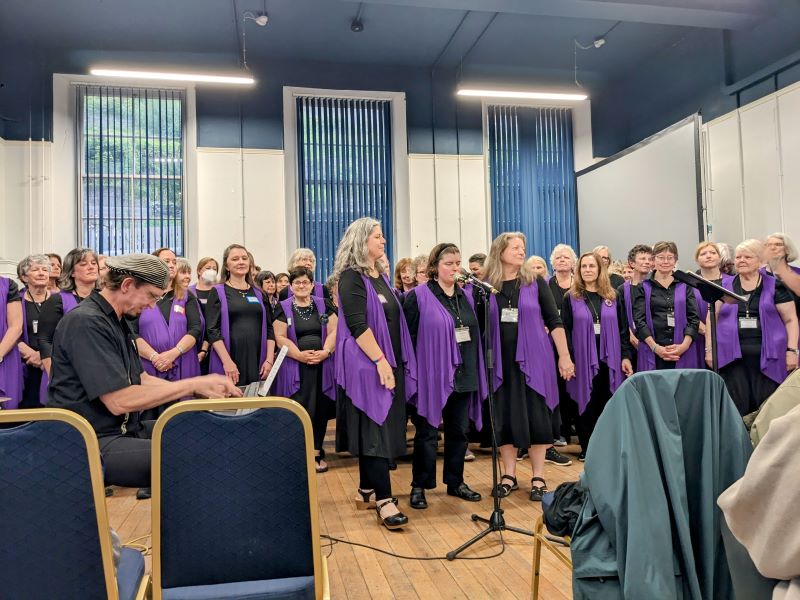
Before I leave Scotland, I just want to share one more place. The nexus of this trip came about when I learned that Voices from the Heart, a women’s chorus from my hometown area in the States, was performing in Scotland. We caught up with them in Oban, a large town of 8,500 people midway between Arisaig and Argyll. I was able to spend the day with my good friend Hilary, a Voices member, and catch up with a number of women I know who are also in the chorus. Such a treat! I leave you with a photo of them singing away!
Hi, all: I was just about to publish this blog in early August when my website blew up. I had to hire someone to essentially recreate it, which took a bit of time. So you are seeing this quite a bit after it was written. Sorry about that!